Indians prostrate before their parents, elders, teachers and noble souls by touching their feet. The elder in turn blesses us by placing his or her hand on or over our heads. Prostration is done daily, when we meet elders and particularly on important occasions like the beginning of a new task, birthdays, festivals etc. In certain traditional circles, prostration is accompanied by abhivaadana, which serves to introduce one-self, announce one’s family and social stature.
Man stands on his feet. Touching the feet in prostration is a sign of respect for the age, maturity, nobility and divinity that our elders personify. It symbolizes our recognition of their selfless love for us and the sacrifices they have done for our welfare. It is a way of humbly acknowledging the greatness of another. This tradition reflects the strong family ties, which has been one of India’s enduring strengths.
The good wishes (Sankalpa) and blessings (aashirvaada) of elders are highly valued in India. We prostrate to seek them. Good thoughts create positive vibrations. Good wishes springing from a heart full of love, divinity and nobility have a tremendous strength. When we prostrate with humility and respect, we invoke the good wishes and blessings of elders, which flow in the form of positive energy to envelop us. This is why the posture assumed whether it is in the standing or prone position, enables the entire body to receive the energy thus received.
The different forms of showing respect are :
Pratuthana - rising to welcome a person. Namaskaara - paying homage in the form of namaste
Upasangrahan - touching the feet of elders or teachers.
Shaashtaanga - prostrating fully with the feet, knees, stomach, chest, forehead and arms touching the ground in front of the elder.
Pratyabivaadana - returning a greeting.
Rules are prescribed in our scriptures as to who should prostrate to whom. Wealth, family name, age, moral strength and spiritual knowledge in ascending order of importance qualified men to receive respect. This is why a king though the ruler of the land, would prostrate before a spiritual master. Epics like the Ramayana and Mahabharata have many stories highlighting this aspect.

Articles in this blog are copied and pasted from various other sites. I want to create at least a minimum awareness among people to understand our politicians and religion. This will help our nation to weed-out corruption at all level
Friday, June 18, 2010


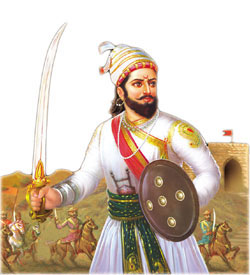
Chatrapathi Sivaji 3
 The Terror Of The Enemies
 Sultan Adilshah saw how Shivaji’s dream of Swaraj would come true, and felt both
anxious and helpless. Every day he received news of some fort or the other falling into Shivaji’s hands! The Sultan had a foster mother, by name Uliya Begum. She hated Shivaji like poison. One day she herself held a Durbar. The far-famed heroes of Bijapur all attended it. At that Durbar Uliya Begum threw out the challenge to all present: "if there is one amongst you who can capture and bring Shivaji captive here, let him accept this token gift of ‘pan’." So saying she held out the silver platter in which was place the
ceremonial ‘pan’ and betel-nut offering. A sever-foot tall robust general stood up and
accepted the gift. The general was Afzal Khan. He was a Pathan general who was as brave as he was cruel and deceitful. The Sultan sent a strong force of 25,000 soldiers to help him.
Afzal Khan first proceeded to destroy Bhavani of Tuljapur, the family deity worshiped by Shivaji. His axe broke. The idol of the Goddess Bhavani of Tuljapur to pieces. The Khan desecrated this idol and another in Pandharput. Shivaji was being informed of all these happenings daily. The Khan knew that as long as Shivaji was safely behind his fortresses and was in the jungle areas, it was difficult to defeat him. He hopped that Shivaji would come into the open plains and offer battle if he indulged in such desecration of temple, slaughter of cows and the molestation of women. Then it would be easier for him to defeat Shivaji.
Shivaji was not slow to understand this scheme; he knew that the Khan would overpower him if the came down from the forts and offered battle. So he made up his mind to proceed to the new fort of Pratapagadh which he had built in the forest of Javali. He then planed to attract the Khan to this place and fight him there. Just at this time he had a dream’ in this dream Goddess Bhavani appeared to them and blessed him saying that he would be victorious.
Afzal Khan wanted to make Shivaji come down from the fort of Pratapagadh and meet him on the plains. Towards this end he sent a representative of his with secret
instructions. He met Shivaji and politely informed him that Afzal Khan was a great of his father and that he did not intend any harm and Shivaji should come down to meet him. In reply, Shivaji sent a flattering letter through his own representative. He wrote, ‘You are like an uncle to me. You must forgive all my crimes. You should come to Pratapagadh and uplift me and take me to the Sultan of Bijapur." The humble and pleading tone of Shivaji’s letter deceived the Khan. And the representative sent by Shivaji praised the courage of the Khan and made fun of Shivaji’s cowardice. So the Khan was very much pleased.
The Khan arrived at the forest of Javali with all his forces. He stationed himself right at the foot of Pratapagadh. It was decided that Shivaji and Afzal Khan should meet as friends. It was also agreed that as Shivaji was a little terrified, Afzal Khan alone should meet Shivaji and the body guards of both should remain at some distance.
It was the night before this meeting. Who could sleep on such a night? Netaji, Tanaji,
Kanoji and other trusted lieutenants of Shivaji came down from the fort and with their battalions, hid in the forest; they stood ready for action. They had been instructed that they should fall upon the enemy ranks and destroy them the moment they heard the booming cannon on the fort. The day dawned. As usual Shivaji bathed, and worshiped Lord Shiva. He put on a metallic helmet to protect the head and a metallic cost to protect he chest. In the scabbard at his waist were the dagger ‘Bhavani’ and a sharp knife. Meditating on Goddess Bhavani he went down from the fort, to meet Afzal Khan. They were to meet halfway down the hill; the place was hidden from view from the came of Afzal Khan. In the shamiana the Khan waited for Shivaji. He rose as soon as he saw Shivaji. Their eyes met for short while. Pretending to offer him the customary embrace of friendship, the Khan invited Shivaji. He stretched both his powerful and long arms in an act of embrace of friendship, the Khan invited Shivaji. He stretched both his powerful and long arms in an act of embrace. It seemed as though it was an embrace of death itself. But whose embrace of death itself. But whose death? Shivaji too came forward and embraced him. At once the Khan drew out his sharp knife and biting his lips in anger thrust it into the side of Shivaji. Shivaji’s steel vesttore with a grating noise, Quickly Shivaji released himself from the hold of the Khan and dragging out his own sharp knife thrust it deep into the entrails of the Khan. The Khan tried to run away. But Shivaji flung his sword at him and at one stroke the head of the khan fell down severed.
Shivaji stuck the severed head of the Khan on his sword and ran up the fort. Simultaneously the cannon also boomed as if it I would cut opens the skies. The Khan’s soldiers were rejoicing, forgetful of the situation in the thought that the Khan would have caught Shivaji. Suddenly the soldiers of ‘Shivaji pounced upon them like leopards. Godess Tulaja Bhavani was now fully avenged. The Khan’s forces were completely destroyed. Shivaji was all-victorious. He sent Jijabai a gift. Can you guess what gift was? The head of Afzal Khan!
Shivaji fame as the slayer of Afzal Khan spread everywhere in our own country and
abroad. A dark and dismal gloom descended on the Sultan of Bijapur. But Shivaji did not grow careless in the joy of victory. Taking advantages of this temp of victory he proceeded to other places and annexed quite a few forts of the Sultan of Bijapur.
The Sultan of Bijapur again chose another general and sent him to attack Shivaji with a force seventy thousand strong. The general, Siddi Jauhar, tried hard to capture Shivaji who was then in Panhalgadh. Even the English came to his assistance with their artillery. The attack gathered more and more strength. Shivaji hoped that the attack would lose its force and strength as soon as the monsoon set in. But in this Shivaji was disappointed. At the same time, in answer to a request from theSultan of Bijapur, the Badshah of Delhi sent his uncle Shaista Khan with an army, ahundred thousand strong, to attack Shivaji. All thought that the hopes of Swaraj and the survival were completely blotted out.
During this period of great danger Shivaji’s mother Jijabai took charge of the administration in the place of her son and managed the affairs ably. In the meanwhile
Shivaji came to the decision that he should few himself from this encirclements. But
how? For Siddi Jauhar guarded the fort from below. Shivaji thought of the less dangerous mode of escape. He sent to Siddi Jauhar through his envoy a letter offering to surrender. He had appealed earnestly that he would surrender unconditionally the next day and that he should be given pardon. The moment news of this surrender reached the soldiers of Jauhar they spent the whole night in great merriment. They hardly knew that such letters from Shivaji were sweet only to deceive. It was night of pouring rain, and terrible thunder and lightning. Just at that moment Shivaji and 800 of his men got down the fort and proceeded stealthily towards Vishagadh. The soldiers posted to watch the enemies were no doubt in their tents, by they were lost in merriment thinking of the surrender of Shivaji. Even the slightest suspicion would have resulted in utter destruction. Hence Shivaji’s men were anxious at every step. But Bhavani’s blessings wee with this mall battalion. They were able to Escape unnoticed.
The group of Mavali soldiers carrying Shivaji in a palanquin ran faster and faster. As they ran the whole area was lit up with a large streak of lightning. One of the spies of Siddi Jauhar noticed the party and he ran to inform Siddi Jauhar of this escape. On hearing this Jauhar was thunder-struck. Still he did not lose heart. He sent for his son-in-law Siddi Masood. He was entrusted with the cavalry and was sent in hot pursuit of Shivaji. Shivaji too felt that it would be difficult to escape from this case. But once again he thought of plan. He sat in another palanquin and traveled in a different direction. There was a man in the army who was like Shivaji. These man put on the clothes of Shivaji and sat in the first Shivaji’s soldiers, captured him and proceeded to Siddi Jauhar. But when the captive was questioned it was found that he was a ‘Shivaji’ by name and was just a barber of Panhalgadh! All were put to shame.
So Siddi Masood again took up the chase. By that time Shivaji and his soldiers had
already covered twenty-five miles and were now near the valley of Gajapur. Vishalgadh was a few miles from there. Five thousands soldiers of Masood raced towards the group. Shivaji had a brave lieutenant, a man strong like Bheema. He was Baji Prabhu Deshpande. He asked Shivaji to proceed to Vishalgadh taking half the force with him. With the remaining half he was their face the mighty battle on of Siddi Masood. It was a sight to see Baji Prabhu wielding two swords in both his hands.
In that narrow valley Baji Prabhu began cutting down the Pathan soldiers who rolled in again and again like waves. In the battle he too was wounded all over the body and blood was flowing out. In spite of this he gave battle till the evening. Many of his soldiers too fell in this battle. Finally Baji Prabhu fell a victim to an enemy’s sword that severely wounded him. At the same time Shivaji had overpowered the soldiers who were attacking Vishalgadh, and climbing up the fort let the cannon resound in Victory. As Bajji Prabhu lay dying he heard this sound. He died in peace, happy that his efforts for his master had not been in vain. The valley was made scatted by the blood of this martyr. From hence this valley came to be known as Pavan Khindi or the Sacred Valley.
The news that Shivaji escaped from Panhalgadh and reached his capital fell on the ears of the Sultan of Bijapur. He felt like one who was struck by a thousand thunderbolts at once. He could not summon again the courage to attack Shivaji. But Shivaji had the other danger from Shaista Khan to attend to. How was he to free himself from this? For this Shivaji chose the month sacred to the Muslims when they observe Ramzan. It was a time when the community would fast all day and then eat sumptuously and be fast asleep at night. The day also was the anniversary of the coronation of Aurangzeb. Need it be said that on that day there would be all the revelry and merriment of a great feast? On that day Shivaji came down from Raigadh with an army of two thousand soldiers. He stationed himself at a distance of some two miles from Poona. Shaista Khan was then camping in the Lal Mahal at Poona, Where Shivaji had been brought up as a boy. In and around Poona a hundred thousand soldiers of the Moghul Emperor were stationed.
A childhood friend of Shivaji by name Babaji moved towards the Moghul camp with a small force of soldiers. Behind him proceeded Shivaji with another small troop. Babaji entered the city, chatting and shouting. The sentries stopped him and his men. But without a moment's hesitation, Babaji said, "We too, are the Khan's men-, we just went out to keep watch and are now coming back." He and his men disregarded the sentries and quietly entered the city. Shivaji's soldiers followed them. Shivaji went directly towards the gates at the rear of the Lal Mahal. From there he went to the Kitchen and cut down all who were there. From there he proceeded to the place where Shaista Khan was sleeping. He had to pull down a small wall that obstructed his entry. A servant heard the wall collapse and went to inform the Khan of what was happening. But the Khan was so sleepy ' that he drove the servant away saying that it must be some rat in the kitchen.
Shivaji and his men rushed in. By that time the entire Lal Mahal was never be rating
with shouts which announced that the enemy had broken in. The wives of Shaista Khan hid him behind a curtain. Shivaji burst in and flung his sword. Three fingers of the Khan, one as it were for the three syllables of the name of Shivaji, were chopped off by this throw.
The Khan jumped down from the window. By then the Moghul army had surrounded the Lal Mahal.In this utter confusion Shivaji and his men shouted, "Catch the enemy, cut him into piece ' s!" They opened the doors of the Lal Mahal and went away. They' escaped and raced to Simhaoadh on the horses that were waiting for them in readiness, This incident convinced Shivaji's enemies that he was not just a mountain rat' but some sort of a fiend or demon, of superhuman powers.Aurangzeb was put to unbearable shame and even transferred Shaista Khan to Ben gal as a punishment.
To build up such a vast kingdom independently and to rule it with an army and a navy, Shivaji needed lots of money. Where could he hope to obtain so much wealth for the purpose? He decided to extract this money from Aurangzeb himself who was enjoying the wealth of this country. In those days Surat was known to be almost the city of Kubera, the God of Wealth. So he attacked Surat on one occasion and then emptied the city of its great wealth.
Chatrapathi Sivaji - 2
 A FORTRESS OF FORTRESSES
 FOR THE GODDESS OF INDEPENDENCE.
Shivaji was born in the fort of Shivneri in 1630. Strangely enough, his task of building up an independent kingdom too was to be accomplished with the help of forts only.Even at the young age of sixteen he captured one of the forts. It was the fort of Toranagadh. Torana! What a beautiful name, full of meaning and significance! It was as though he had woven an auspicious garland for independence. The saffron colored sacred banner, the Banner of the Lord, ‘Bhagavajhenda’, fluttered on the fort. Shivaji ordered his soldiers to strengthen the fort, this first fort that was to lead to independence. When the ground was being dug in the fort, the diggers saw hidden treasures. Was that the first gift of the goddess of Fortune to the Goddess of Independence? Strangely, the poor diggers who came by so much wealth were not in the least move by thoughts of greed. The carried the entire treasure to Shivaji handed it over to him. They knew it was wealth granted for the struggle for independence. It belonged to the lord and they were not to touch it.
After Toranagadh Shivaji began to capture one fort after another. The news that Shivaji was capturing forts reached the Sultan of Bijapur. In order to crush Shivaji the Sultan hit upon a treacherous plan. He got Shahaji captured by deceitful means; then Shahaji was brought to the Sultan’s presence and was thrown into prison. A rumor spread that Shahaji would be tortured and executed.
This news was like a thunderbolt to Shivaji who was rejoicing in the birth of an era of
independence. His other Jijabai was heart-broken. She felt as if the God of Death himself was about t snatch her sacred ‘mangalya’ (The symbol of a life-long partnership with the husband). On the heels of this news came tow other bits of frightening news: one, that Fateh Khan, the valiant Sardar of Bijapur, was proceeding against Shivaji with a large army; another, that Farrad Khan yet another valiant general was attacking Sambhaji, the elder brother of Shivaji, It was clear the Sultan was posing these threats only to see that Shivaji gave up fighting and surrendered to him. If he did not surrender, if the continued to fight, his father’s life would be in danger. Shivaji was worried, not knowing what he should do. At this juncture his fourteen year-old wife, Sayibai, said to him; "why do you worry yourself over this? See that your father is freed. See to it also that you retain this state of independence. Destroy your enemies." She was a worthy wife of hero like Shivaji, wasn’t she?
Shivaji came to a decision.The commander of Purandaragadh was in the employ of the Sultan of Bijapur; Shivaji won his heart with soft-spoken, friendly words. He stationed a small army there. The soldiers of Shivaji fought against Fateh Khan who attacked the fort. This was the first test of the battle for independence. So valiant were the men of Shivaji that Fateh Khan had to retreat and run away. Elsewhere Sambhaji to broke the back of the attack of Farrad Khan.
All this was victory. But how was he to save his father? Shivaji was deeply trouble by this thought. Suddenly, like a flash of lightning, a plan occurred to him. His intellect was as sharp as his arms were supple. Shahjehan was the Emperor in Delhi at that time. So he wrote to Emperor: "My father is kept captive by the Sultan of Bijapur. As soon as he is released my father and I will willingly serve you. We are very eager". The Sultan of Bijapur came to know of this. He knew well that theEmperor of Delhi was waiting for an opportunity to attack him. He feared what would happen to him if the Emperor decided to attack him. So with all due honor the released Shahaji. With his valor and his diplomacy, Shivaji thus overcame the first great danger to freedom
Shivaji was twenty-eight. By then Kondana, Purandara, Kalyan, Raigadh and other forts numbering forty flows the flag of freedom. It was also at this time that on the West Coast the English, the Portuguese and other foreigners set foot. Shivaji was apprehensive that some day these foreign armies might occupy the whole land. Intent on containing them he began building fortresses by the sea. He began to equip himself with warships and trained the navy. Shivaji was the first among those who in their farsighted vision saw the lurking dangers of foreign domination, and acted to check such aggression.
Thursday, June 17, 2010
Sister Sonia, Gandhiji wanted a total ban on conversions!

“The Congress party's views on this are well known,” Sonia says. ‘This’ means laws banning forcible religious conversions. She goes on: “They are enactments passed by state legislatures where the Congress is in opposition.” She adds, “The Congress party has opposed (them) strongly in the assembly and through demonstrations.” She made these profound remarks in a letter she wrote to Dr John Dayal. Who is he? He has a respectable visiting card, as member of the National Integration Council. But he has other visiting cards too like President of All India Catholic Union, Secretary General of All India Christian Council, President of United Christian Action, and Member of Justice and Peace commission Archdiocese of Delhi.
But these cards do not exhaust his definition. In the assessment of a responsible Christian scholar, PN Benjamin, who runs the Bangalore Initiative for Religious Dialogue, “John Dayal opens his mouth and wields his pen only to spew venom on the Hindu community.” This completes his profile. He had written to Sonia complaining about the laws banning religious conversions in different states. To which she replied implying that the BJP is the author of anti-conversion laws.
But is that - that is, it is the BJP, not the Congress, which passed the anti-conversion laws and the Congress had actually opposed them - a fact? Only a novice in political history post freedom would say something like what Sonia says. On the contrary, it was the Congress Party, which had still some traces of the Mahatma Gandhi left in it, that had passed the anti-conversion laws.
That Congress, which still had some respect for the Mahatma, took his words on religious conversions seriously. Mahatma Gandhi had written extensively against conversions by Christians. He wrote, “I hold that proselytisation under the cloak of human work is unhealthy to say the least.” This was in Young India on April 23, 1931. Later, he went one step further and wrote, “If I had the power to legislate, I should stop all proselytisation work” (Young India 5.11.1935). He told the missionaries, “He is ashamed of them” (Young India 8.8.1925), disputed their claim that theirs “is the only true religion” (Harijan 3.6.1937), warned that “conversion should not mean denationalisation” (8.8.1925), and pointed out that it means just that, as many converts are “ashamed of their birth” and of their ancestry (20.8.1925).
Gandhiji's ideas were still influencing the Congress when the Madhya Pradesh government constituted the Neogi Committee to study missionary activities in tribal areas. This was in 1954. S.K George, ‘a devout Christian and a nationalist belonging to the oldest church in India - the Syrian Christian Church' was a member of the Committee. The Committee exposed the massive, fraudulent conversions of tribal people and recommended that a law be enacted to ban such fraudulent practices. The MP government, led by the Congress Party, enacted the Neogi-recommended law banning conversions in the year 1968. The Orissa government, again a Congress-led government, did so even earlier in 1967. And Arunachal Pradesh under the central rule of the government headed by another Gandhi, unrelated to the Mahatma, Indira Gandhi, also passed a similar law.
This is the origin and history of anti-conversion laws in India. So these laws owe their origin in Mahatma Gandhi's wish. He actually wanted a ban on all religious conversions. These laws fall far short of his wish. But she would not know that Gandhiji wanted a total, not partial, ban on conversions. She would not know that it was the Congress in which Gandhi's views were respected which passed these laws first. One can also dismiss her ignorance of the history of a country she is totally unfamiliar as natural. But the tragedy is that, by design, not by accident, this nation itself has kept its people and polity so ignorant of the views of that Gandhi that many today think that this Gandhi's views are also that Gandhi's views!
His statues in lakhs are all over the country from small village panchayat offices to Parliament. Roads running to hundreds of thousands of miles bear his name in every small town. His name is alive through his statues and roads but his ideas are nowhere. That is why the later Gandhis saw the political gain in appropriating his name but rejecting his ideas. Just like the name Gandhi is all over but his ideas are nowhere, the name Congress is all over but Gandhi's ideas are nowhere in the Congress. So, while Mahatma Gandhi had commended a ban on conversions, the Congress led by Sonia Gandhi is opposing even a ban on fraudulent conversions. The difference between the two Congresses is as much as the difference between the two Gandhis - today's Sonia Gandhi and yesterday's Mahatma Gandhi.
Measuring Time
| 1 Nimish | = | @ 0.213 sec | Time required to blink an eye. |
| 1 Kastha | = | 15 Nimish | |
| 1 Kaal | = | 30 Kastha | |
| 1 Muhurta | = | 30 Kaal | |
| 1 Day | = | 30 Muhurta | 15 for the day and 15 for the night. |
| 1 Month | = | @ 29 Days | The Lunar Month starts one day after new moon to next new moon. The Lunar month is approximately 29 days. |
| 1 Year | = | 12 Months. | Lunar Year is approximately 354 days. Solar year about 365.25 days. When the accumulated difference between the Solar year and Lunar year exceeds 29 days, an extra month Adhika maas is added to the lunar year. |
| Yug Ganana: | |||
| SatyaYug | = | 1,440,000 years | |
| TretaYug | = | 1,080,000 years | |
| DwaparYug | = | 720,000 years | |
| KaliYug | = | 360,000 years | |
| Sandhi kaal | = | 720,000 years | Period between two yugas |
| 1 MahaYug | = | 4,320,000 years | 1 cycle of Satya, Treta, Dwapar & Kali Yug. |
| 1 Manvantr | = | 71 MahaYug | The number of years in the Yugas vary in different sources. But the total of all the Yugas (MahaYuga) comes to 4,320,000 years in each account. |
| 1 Kalpa | = | 14 Manvantr | (Jan 2000 CE is year 5102 of the Kali Yug of 28th MahaYug, of 7th Manvantr, of 1st Kalpa.) |
| 1 Brahama day | = | 2 Kalpa | (approx 8.7 billion years). One Kalpa for day, one Kalpa for night. |
| 1 Nimish of Vishnu | = | 100 years of Brahma | |
| 1 Nimish of Rudra | = | 100 years of Vishnu | (how many years is that???!!!) |
Time is measured with the help of of 4 Mandala's: Chandra, Pruthvi, Surya, and Parmeshthi. Each Mandala denotes the time required for a revolution around its parent.
- Chandra Mandala: is revolution of the Moon around the Earth. Time it measures is a Month.
- Pruthvi Mandala: is revolution of the Earth around the Sun. Time it measures is a Year.
- Surya Mandala: is revolution of the Sun around the Centre of the Milky Way. Time it measures is a Manvantar. @300 million years (by modern sciences this figure is @250 million years)
- Parmeshthi Mandala: is revolution of the Milky Way around Brahmanda (Universe?) Time it measures is a Kalpa 8.7 billion years.
Daily Prayers To Mother India
EKATMATA STOTRA
Om Namah Sacchidaananda,
roopaaya paramaatmane |
Jyotirmaya Swaroopaaya,
Vishwa Maangalya Moortaye || 1 ||
Translation:
Aum I bow to the supreme Lord who is the very embodiment of truth, Knowledge and Happiness, the one who is enlightened, and who is the very incarnate of universal good.
roopaaya paramaatmane |
Jyotirmaya Swaroopaaya,
Vishwa Maangalya Moortaye || 1 ||
Translation:
Aum I bow to the supreme Lord who is the very embodiment of truth, Knowledge and Happiness, the one who is enlightened, and who is the very incarnate of universal good.
Understand the Ramayana in different perspective

Soul Ramayana
Rama is a symbol of our soul. Ramayan is Ram+Ayan. It means the journey of Rama, symbolising the way our soul advances. Rama, like our soul, is without faults and is of divine origin, having been born as a blessing of the divine nectar given by the gods to King Dasaratha as a result of the Puthrakameshti Yagna performed by him. Like Krishna, Rama too is an incarnation of Vishnu, that virtual part of the Paramatma, the ultimate Soul or power which sustains Creation. Like Krishna, Rama too is blue-hued as blue signifies eternity.
The Soul entity does not usually take birth by itself. It is accompanied by other fellow souls who are also of divine origin. Rama’s brother Lakshmana is one such. He accompanies Rama into exile. Bharata and Shatrughana, the other two elements of the Soul entity, stay behind and take care of the kingdom in Rama’s name.
The Soul is wedded to the body, symbolised by Sita. Sita is considered the daughter of mother earth, as she was found by Janaka, king of Mithila, in a furrow in a field and raised by him and his wife Sunayana. Our bodies, too, are made of the elements provided by the earth.
As a step in Rama’s journey through life, he is sent into exile. Indeed, the very birth of the Soul in physical form can be considered an exile for the Soul. During his exile, he is accompanied by his wife, as, indeed, the Soul is accompanied by the body during our time on the earth.
While here, the body often desires riches and beautiful objects. The golden deer is symbolic of these objects of desire. In pursuit of these, Sita gets kidnapped by Ravana, the symbol of our mind. Some think that the 10 heads symbolise the five sense organs and the five motor (or cognitive) organs of the human body described in the Vedas.
Ravana’s heads symbolise the tendencies of our mind. Our mind is clever and powerful like Ravana and can be demonic like him, too. It is related to Kumbhakarna, the embodiment of gluttony and sloth. It is related to Vibhishana, too, the part of our mind which leaves behind its demonic origin to take the side of the good.
Our mind has many ‘heads’ and it is not possible to kill them one at a time, for the moment one head is removed another takes its place. We have to remove all the tendencies of the mind at one go and overcome the mind in order to regain our divine place.
To get Sita back from Ravana, Rama is helped by Hanuman and his vanar sena. He is helped, too, by the bear army under Jambvant. These represent the forces of nature, which come to the aid of those who dare. Some of these forces are malevolent, too, like Sugreeva’s brother Bali. The divine in us helps us overcome forces of evil, too.
When Sita goes through the test of fire — agnipariksha — it is only symbolic of the body that is burnt once the Self overcomes the mind. Rama’s journey is complete and his exile is over.
With so many plots and sub-plots, underlying themes and messages and interesting characters, the stories of the Ramayana continue to engage us. With its many interpre-tations and versions, the epic means different things to different people, rich in content and symbolism.
Kishore Asthana
http://www.mahanbharat.net/soul-ramayana
Subscribe to:
Posts (Atom)